6/15/2015

Is booze at breakfast the best way to start the day?

Barack Obama with his breakfast beer

The sight of Barack Obama downing a pint at his pre-G7 summit Alpine breakfast on Sunday was surprising and cheering in equal measure. Drinking early in the day doesn’t usually come with such official approbation. We tend to think of morning drinks in extremes – a bloody mary or swift half to provide a much-needed quick fix after a long night, or perhaps bubbles for special occasion breakfasts. However, in many parts of the world, booze at breakfast is seen as a perfectly normal way to start the day.
The weisswurst frühstück Obama was enjoying is a beery Bavarian stalwart: boiled sausages with mustard, freshly baked pretzels and a cold weissbier, the operative word here being cold. Alcohol in the morning must be fresh and zippy. A bit of fizz, something dry, a hint of sweetness, a sharp kick – as drinks writer Henry Jeffreys puts it, “it’s the pick-me-up that makes you mellow”. Beer or ale for breakfast is not uncommon in the rest of northern Europe, particularly in Belgium – and even, until as late as the 1980s, in England, where breweries would give free drinks to their workers. While this was probably to counter pilfering, it also continued a long tradition of brewers enjoying a hearty brew to start the day, harking back to the “liquid bread” of 16th-century friars. It would seem there is more to an early-morning pint than just hair of the dog.
Around the Mediterranean, you’ll often see older patrons having a caffè corretto, the espresso quite literally “corrected” with a shot of something stronger: grappa, sambuca or brandy. It is a habit Mitch Tonks and Mat Prowse adopted at a fish market in Spain 15 years ago; they call it their morning fire. The grappa is sometimes substituted with armagnac, Fernet-Branca or whatever other local spirit the two chefs encounter on their travels. “It takes the body by surprise,” writes Tonks in his new cookbook, The Seahorse. “We have found that in this moment of lightness and clarity we have made our best decisions.” Which makes the Seahorse restaurant staff living proof that drinking in the day might not actually render working minds as useless as you’d think. It’s all about being restrained: “The trick is to have just one glass,” says Tonks, “otherwise the surprise is spoiled.”
London wine bar Vinoteca has just opened a Kings Cross branch, the first to serve breakfast. “You don’t have to not drink wine early in the day,” counsels co-owner Brett Woonton. Woonton and his partner, Charlie Young, focused on bottles that would work best with breakfast, plumping for lightness and freshness over full-bodied heft; drinks that would be accessible and approachable. So they have got a pink moscato, the sweet, fruity fizz of which sits handsomely with a plate of pancakes; a slightly frizzante, dry red bonarda that cuts judiciously through the richness of a meaty breakfast; and a German riesling to pair with fresh fruit or muesli.
For Woonton, a good breakfast wine should be the oenological equivalent of an early-morning swim: invigorating and enlivening. And that is a strategy tried and tested in Sicily. Food writer Rachel Roddy, the author of Five Quarters, says her partner’s grandfather, a Sicilian farmer, “drank a litre of white with his breakfast of bread and caponata every single morning at six”. That would be followed by a whole lemon, eaten like an apple, before he left the house. “He also drank a litre for lunch,” she continues “and never drank water. He was tiny, without fat, as strong as a horse and he lived until 95.”
The thought of all that wine, particularly without water, is a terrifying prospect, but there may well be something in it in moderation. Breakfast, it is becoming increasingly clear, is the meal of the day – maybe a celebratory tipple should become a mainstay on the menu.

4/13/2015

A Spanish feast in Springtime

Spring in Spain is a season of abundance: juicy artichokes, fresh green peas, wonderfully robust asparagus and, of course, bright, leafy spinach – a staple in many Spanish dishes. My mum used to whip up a fresh mayonesa to go with our artichokes and we would all sit round the table in silence as we tucked in, engrossed in our ritual of pulling off leaf after leaf to dunk in the creamy dip. And after the green, comes fish. Whole baked turbot is extravagant, but it’s a perfect dish with which to gather friends round the table for a feast.

Whole baked turbot with onions, lemon and caper salsa

All recipes serve 6
turbot 1 x 2kg or 2 x 1kg, trimmed and gutted by your fishmonger
olive oil a good drizzle
For the salsa:
sweet onion 1
lemon juice of 1
capers 2 tbsp, drained and rinsed
parsley a handful, finely chopped
lemon thyme 2 tbsp
extra-virgin olive oil 4-5 tbsp
Heat the oven to 200C. Place the turbot(s) in a large roasting tin and drizzle with oil. Season well and roast for 20 minutes for a 1kg turbot or 30-35 minutes for a 2kg turbot, until just cooked. Insert a knife into the thickest part of the meat near the bones and if it comes away from the bones easily it is cooked.
To make the salsa, very finely slice the sweet onion and place in a bowl with the lemon juice, capers, herbs and olive oil. Season to taste.
Once the turbot is cooked, you can either pop it under the grill to crisp the skin or remove the skin.

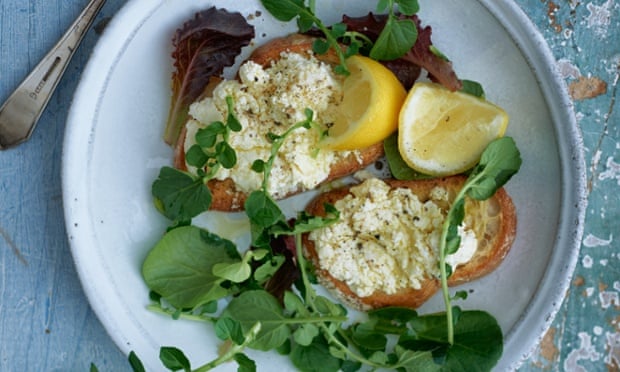
Spring leaves with curd cheese

Spring leaves with curd cheese
Spring leaves with curd cheese. Photograph: Jean Cazals/Observer
full-fat milk 1 litre
cloves 3
black peppercorns 10
lemons juice of 1 or 2
baby salad leaves
extra-virgin olive oil to drizzle
squeeze of lemon juice
To make the cheese, heat the milk with the cloves, peppercorns and a pinch of salt in a saucepan over a medium heat. When it starts to bubble, around 98C, remove from the heat. Don’t let it boil. Add the juice of one lemon and stir. Stand for 10 minutes until the curds have separated from the whey. If you need to you can add a little more lemon juice, a tablespoon at a time.
Line a colander with muslin, add the curds and whey and strain into a bowl. Leave for 30 minutes, squeezing gently to remove most of the liquid from the cheese. Leave to cool then scoop into a container and chill until needed.
Toss the salad leaves with the olive oil and a squeeze of lemon juice and crumble the cheese all over. Season with sea salt and pepper and serve.

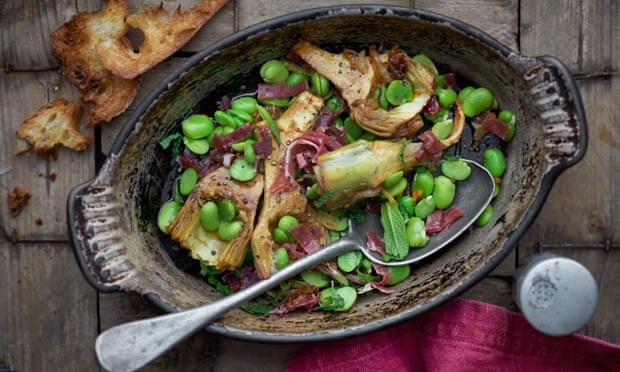
Artichokes and broad bean estofado with jamón ibérico and mint

Artichokes and broad bean estofado with jamón ibérico and mint
Artichokes and broad bean estofado with jamón ibérico and mint. Photograph: Jean Cazals/Observer
baby artichokes 12
lemon 1
olive oil 100ml
banana shallots 2
garlic 3 cloves
broad beans 400g, fresh
jamón ibérico 100g
mint 2 tbsp, fresh, chopped
Trim the baby artichokes, removing any tough outer leaves, and cut in half. Place in a bowl of water and squeeze in the juice of half the lemon.
Heat a little of the oil in a deep frying pan. Finely slice and fry the shallots until softened then add the garlic and fry for a little longer. Drain the artichokes and add to the pan with the broad beans. Season well and add the rest of the olive oil, the juice of the other half a lemon and just enough water to cover.
Put on a lid and simmer for 20 minutes until tender. Remove the lid. Finely slice the jamón and stir through with the mint. Serve warm.

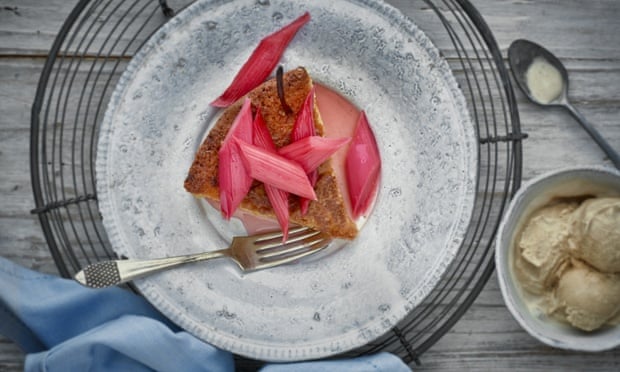
Almond and pear cake, slow-roasted rhubarb and Pedro Ximenez ice cream

Almond and pear cake, slow roast rhubarb and Pedro Ximenez ice cream
Almond and pear cake, slow roast rhubarb and Pedro Ximenez ice cream. Photograph: Jean Cazals/Observer
unsalted butter 150g, softened
caster sugar 125g
free-range eggs 2, medium-sized
ground almonds 150g
baking powder 1 tsp
plain flour 2 tbsp
pears 2, ripe but firm
demerara sugar 2 tbsp
rhubarb 800g
caster sugar 150g
whole milk 300ml
vanilla pod 1
free-range eggs 6 yolks
caster sugar 175g
double cream 600ml
Pedro Ximénez sherry 120ml
Make the ice cream. Heat the milk with the vanilla pod – split in half and seeds scraped out – until almost boiling. Whisk the egg yolks and caster sugar until really thick and fluffy. Pour in hot milk and stir well then strain back into a clean pan.
Cook over a medium-low heat until you have a thick custard. Remove from the heat, cool slightly and then add the cream and cool completely. Once cold, stir in the sherry and churn in an ice-cream maker until solid. Scoop into a tub and freeze. If you don’t have a machine, cool and freeze the mix until it starts to become solid, then whisk with an electric hand whisk and re-freeze. Repeat 3-4 times then freeze overnight.
Heat the oven to 140C. Cut the rhubarb into lengths and place in a roasting tin. Scatter with caster sugar and pour over 80ml of water. Cover with foil and roast for an hour until tender but still holding its shape. Remove from the oven and allow to cool in the juices.
Increase the oven to 180C. Grease and line a 20cm round cake tin. Cream the butter and sugar together until light and fluffy. Add the eggs, one at a time, beating together, then fold in the almonds, baking powder and flour. Spoon into the cake tin. Peel and core the pears and cut into wedges. Place all around the cake, pushing in a little but not completely. Sprinkle with the demerara sugar. Bake until risen and golden – about 45 minutes or until a skewer inserted into the middle comes out clean. Allow to cool for 10 minutes, remove from the tin and cool on a wire rack. Slice the cake into wedges and serve with the roasted rhubarb and a scoop of the PX ice cream.

3/10/2015

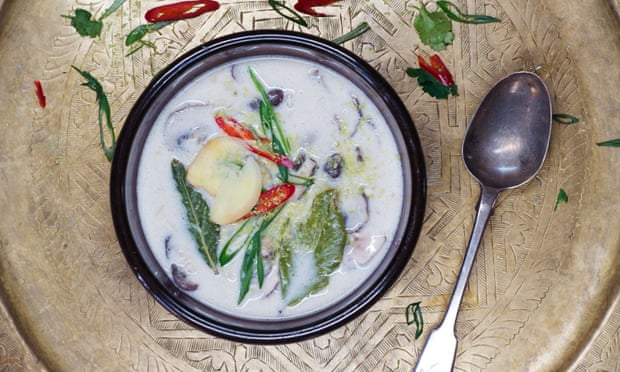
Jack Monroe’s tom kha gai soup recipe

Jack Monroe's tom kha gai.
I first had this delicious, spicy coconut soup on a pavement outside a pub in Shepherd’s Bush, London. Thai food has become popular in pubs over the last few years; on a recent adventure up north I found more pubs offering Thai cuisine than hotpots. I had my second taste of tom kha gai in a boozer in Bolton. Then a bowl at Thai street food place Jane-Tira in Soho sealed the deal – I decided it was time I made my own.
Soft, sweet, spicy and satisfying, it has become a work lunch staple, simmering away behind me on the hob as I write at my kitchen table. I’ll add a pile of shredded chicken if there is a carcass left from the weekend, but more often than not I’ll do without. I use ginger in place of hard-to-find galangal, and lemongrass paste to speed things up – it is easy enough to make, and freezes well or keeps in the fridge for around a week.
(Serves 3-4 for lunch)
2 stalks lemongrass, chopped
2 tbsp olive oil, plus extra for lemongrass paste
10g fresh ginger root, minced
2 fat cloves of garlic, minced
100g spring onions, finely sliced
400g mushrooms, sliced
1 small red chilli, deseeded and sliced
Zest and juice of a lime
1 tbsp light soy sauce
400ml coconut milk
700ml chicken or vegetable stock
A small handful of coriander
Put the lemongrass pieces into a blender with oil and blitz until you have a smooth paste.
Heat the oil on medium with two teaspoons of the lemongrass paste, the ginger and garlic.
Add the onions, mushrooms, and chilli. Cook on a low, slow heat for a few minutes to soften the onions and take the raw edge off the garlic.
Add the lime juice, soy sauce, coconut milk and stock – you may not want all the stock, so taste as you go.
Bring to the boil, reduce to a simmer and cook for a further 15 minutes to let the flavours infuse.
Serve garnished with coriander and lime zest.